
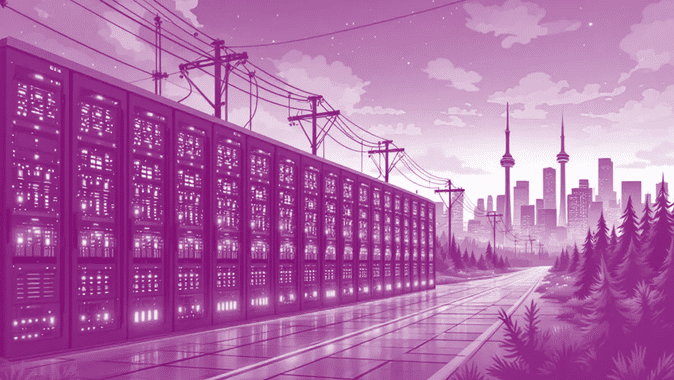
The Canadian AI & Energy Convergence – from collision to strategic course
An analysis of the forces shaping Canada’s role in the global AI economy – and the decisions that will determine which of four futures arrives by 2035: the Northern Powerhouse, the Landlord Economy, the Patchwork Province, or the Missed Window.
| >80%
of Canada’s electricity is non-emitting CER, 2025 |
$25B
AWS committed to Canadian data centres RBC, 2025 |
945 TWh
projected global data centre demand by 2030 IEA, 2025 |
The Collision Course: Why AI and Energy in Canada Are Now One Story
The convergence argument
There is a particular moment in the history of any great industrial transformation when two separate worlds – each vast, each self-contained, each operating on its own logic and timeline – suddenly discover they cannot survive without each other. We are living through that moment right now, in Canada, at the intersection of artificial intelligence and energy.
This is not a technology story. Or rather, it is not only a technology story. It is a story about physics. About power. About a civilisation that built a machine so hungry for electricity that it has forced an entirely new reckoning with how we generate, distribute, and price energy – and who gets to decide.
It is, in short, the most consequential industrial convergence Canada has faced since the country electrified itself a century ago.
The Machine That Ate the Grid
In the summer of 2022, something unusual happened inside the world’s data centres. For years, the engineers who built and operated these facilities had performed something close to a miracle: global data workloads had nearly tripled between 2015 and 2019, yet energy consumption had barely budged. Efficiency gains – better chips, smarter software, more intelligent cooling – had somehow absorbed the explosion in demand.
Then came the large language models. ChatGPT launched in November 2022 and within two months had more than 100 million users. What most people didn’t appreciate – what most people still don’t appreciate – is that this was not merely a product launch. It was an energy event. The physics are unforgiving. Training a single large AI model can consume as much electricity as hundreds of thousands of households use in a year. And inference – actually running the model, answering queries, generating outputs – never stops. Every prompt, every image, every synthesised document is a tiny withdrawal from an electrical account that must be perpetually replenished.
| 10×
more electricity consumed by a ChatGPT query vs Google search CER / IEA, 2024 |
945 TWh
projected global data centre electricity demand by 2030 IEA Energy and AI, 2025 |
~15%/yr
annual growth rate of data centre consumption 2024–2030 IEA — 4× faster than all other sectors |
The International Energy Agency projects that global data centre electricity consumption will reach approximately 945 terawatt-hours by 2030 – nearly double 2024 levels, roughly equivalent to the entire annual electricity consumption of Japan. The computational energy demands of training increasingly sophisticated AI models have been doubling approximately every nine months.
Canada: Accidentally Positioned for Everything That Comes Next
Here is where the story gets interesting. Because if you were designing a country from scratch to thrive in this new world – a country positioned to benefit from the collision of AI and energy – you might design something that looks remarkably like Canada.
Over 80% of Canada’s electricity comes from non-emitting sources. The country possesses vast hydroelectric systems in Quebec, British Columbia, and Manitoba that produce some of the cheapest, cleanest electricity on the continent. It is cold – genuinely cold, nine months of the year in most of the country – which dramatically reduces the cost of cooling the servers that power AI. And it has already produced world-class AI research clusters in Montreal, Toronto, and Edmonton that are recognised globally as among the most productive concentrations of machine learning talent anywhere.
The economics are startling. Industrial electricity rates in Montreal hover near CAD $0.05 per kilowatt-hour. Compare that to data centre hubs in Arizona, Illinois, and Texas, where US industrial power prices run 30–40% higher – and that’s before accounting for the extra 20–40% of cooling power those warm climates require.
Global hyperscalers have noticed. Microsoft has committed to a CAD ~$700 million AI training campus in Quebec City. Amazon Web Services has committed to invest $25 billion in Canadian data centres. When the world’s most powerful technology companies decide where to locate the infrastructure of the AI economy, Canada keeps appearing on the shortlist.
If all the data centre projects currently under regulatory review proceed, they would account for 14% of Canada’s total power needs by 2030. The question is not whether Canada is positioned for this moment. It clearly is. The question is whether Canada has the institutional will to convert that positioning into durable national benefit – rather than selling the timber to someone else who builds the house.
Structural Advantages – and Hidden Vulnerabilities
Canada’s assets and vulnerabilities
Think of the railway. In the 1870s, Canada possessed something extraordinary: a vast continental landmass sitting between two oceans, rich with resources, capable of knitting together an entire hemisphere of trade. The transcontinental railway was the instrument that translated geography into economic destiny. Without it, the advantage would have remained theoretical. Potential without execution is just scenery.
Canada finds itself in a structurally similar position today. The country has stumbled into a nearly perfect confluence of assets for the AI-energy economy – clean power, cold climate, technical talent, and political stability – at precisely the moment the world is desperately looking for all four. The question, as it was in 1871, is whether Canada will build the railway. Or whether it will sell the timber to someone else who will.
A Province-by-Province Reality
Canada is not a monolith. It is a federation of distinct energy systems, each with its own grid, its own regulator, its own political economy, and its own approach to the AI-energy opportunity. Understanding Canada’s structural position requires understanding that ‘Canada’ is really five different stories playing out simultaneously.
| QC | QUEBEC – The Crown Jewel. Nearly 100% renewable hydro at some of the lowest industrial rates in North America. Hydro-Québec has identified data centres as the largest new line item in its supply plan. Bill 69 now requires ministerial authorisation for any new load above 5 MW. The proposed 13¢/kWh data centre tariff reflects a deliberate attempt to capture the clean energy premium. |
| ON | ONTARIO – The Balancing Act. Nuclear backbone, Toronto AI talent cluster, and a large industrial base competing for the same grid. The IESO has the longest large-load queue in its history – 37 projects totalling 6.5 GW. Data centres must compete with manufacturing, EV adoption, and building electrification for capacity that is genuinely constrained. |
| AB | ALBERTA – The Capability Gap. Thirty-seven data centre proposals against effectively zero available grid capacity. The ‘bring your own generation’ model creates flexibility but disqualifies projects from clean energy PPAs under hourly matching standards. Carbon intensity is the province’s most urgent commercial liability. |
| BC | BRITISH COLUMBIA – The Constrained Opportunity. Bill 31 caps new data centre grid allocations at 100 MW per applicant – a deliberate rationing mechanism reflecting genuine supply constraints from Site C and demand growth. |
| MB | MANITOBA – The Transitioning Hub. Possesses a vast northern hydro network, though a multi-year drought and aging infrastructure have exhausted immediate surplus, minimal talent cluster, and limited fibre connectivity. The province most likely to benefit from interprovincial coordination it currently lacks the institutional leverage to create. |
The Four Hidden Vulnerabilities
Canada’s structural advantages are real and measurable. But they are not self-executing. Four structural vulnerabilities, left unaddressed, could convert Canada’s position of advantage into a position of disappointment.
| V1 | Constitutional fragmentation
The most important electricity infrastructure decisions in the country are made by ten different provinces and three territories, each with its own regulator, each optimising for its own political economy. A new (March 2026) national energy policy framework to enable interprovincial power exchange, and to begin evaluating whether Canada as a whole is building the right infrastructure in the right places at the right speed. |
| V2 | Brain drain at the frontier
Canada accounts for 10% of the world’s top-tier AI researchers – but that share is under sustained pressure. Mila PhD retention is approximately 48% within two years of graduation – below the 55% confidence threshold. The differential between Canadian and US compensation for senior AI engineers has widened to 25–30%. The talent Canada trains is the talent the world’s best-funded labs are recruiting. |
| V3 | Transmission timeline gap
New transmission infrastructure takes 8–12 years from approval to operation. AI-driven demand is materialising in 3–5 year cycles. The gap between the speed at which new load is seeking grid connections and the speed at which new transmission can be built is the single largest physical constraint on Canada’s AI-energy buildout. |
| V4 | The sovereignty paradox
Canada is attracting the world’s most powerful technology companies to build infrastructure on Canadian soil – but without conditionality frameworks, that infrastructure is foreign-owned, foreign-operated, and ultimately foreign-benefiting. The physical address is Canadian. The economic sovereignty is not. |
The Relative Certainties: Six Forces We Can Plan With Confidence
What we can build on
In 1944, the Allied war planners making decisions about the Normandy invasion did not know exactly where the German defences would be weakest. What they knew – with as much confidence as the fog of war would allow – was that the fundamental arithmetic of the operation was sound. Strategy under uncertainty has always worked this way: first identify what you can know, build a foundation on those things, then design around the uncertainties that remain.
In the convergence of AI and energy in Canada, there are forces so clearly established – grounded in physics, committed capital, contractual obligation, and demonstrated performance – that we can treat them as bedrock. Here are six of them.
| RC 1 | AI electricity demand will grow substantially and durably
This is not a forecast. It is already contractually committed. Microsoft has 40 GW of clean power contracted as of February 2026 – making it the largest single buyer of clean electricity on earth. Amazon, Google, and Meta collectively account for 49% of all global corporate clean energy procurement. In Canada specifically, if all data centre projects currently under review proceed, they would account for roughly 14% of Canada’s total electricity needs by 2030. Ontario’s IESO has revised its 25-year demand growth forecast upward by 75% – the most significant upward revision in the province’s planning history. |
| RC 2 | Clean energy will command a durable price premium
The hyperscalers have made legally binding net-zero commitments. They will pay for clean electrons. Google has committed to 24/7 carbon-free electricity on every grid where it operates by 2030. Data centre operators accounted for 43% of all clean power purchase agreements globally in 2024. A megawatt-hour of Quebec hydro is not the same product as a megawatt-hour of Alberta gas. It is worth more – and the premium will increase as GHG Protocol standards tighten toward hourly matching requirements. |
| RC 3 | Nuclear energy – including SMRs – will play a significant role
On May 8, 2025, Ontario approved Ontario Power Generation’s plan to construct the first of four small modular reactors at the Darlington nuclear site – the first SMR approved in the G7. At $20.9 billion and targeting first criticality by 2030, this is the most consequential energy infrastructure decision in Canada since the original CANDU programme. It is not a future event. It is underway. |
| RC 4 | AI will reduce energy operational costs
The same AI systems driving electricity demand are also the best tools available for managing complex grids. Predictive maintenance, demand forecasting, load balancing, and outage prevention – these applications have demonstrated ROI across utilities globally. The energy sector’s own costs will be compressed by the technology it is being asked to power. |
| RC 5 | Data governance and cybersecurity requirements will tighten
The combination of critical infrastructure dependency and foreign ownership creates regulatory pressure that is building across every advanced economy. Canada’s soon to be tabled AIDA successor, and provincial privacy frameworks will establish increasingly clear requirements for where sensitive AI workloads must be processed and by whom. This is a certainty – the only uncertainty is timing. |
| RC 6 | The federal government will remain a significant actor
The $2 billion Sovereign AI Compute commitment, $3 billion in Darlington SMR support, and $9.4 million AI Pathways initiative represent the opening act of a sustained federal role. The precise shape of that role will evolve – but the federal government will not exit this field. Plan with that. |
The Critical Uncertainties: Six Forces Whose Resolution Will Shape Everything
What cannot be predicted
In 1962, Edward Lorenz was running a weather simulation at MIT when he discovered that a difference of one part in a thousand in initial conditions produced wildly divergent outcomes. He called it sensitive dependence on initial conditions. We call it the butterfly effect. A critical uncertainty is not simply something we don’t know – it is something whose resolution will send the future down fundamentally different paths.
In the convergence of AI and energy in Canada, there are six forces that are equally consequential to the relative certainties – but whose direction we cannot honestly predict. Two will become the axes of the scenario matrix. All six deserve to be named and understood clearly, because the quality of any strategy depends entirely on whether you’ve thought through what happens if each one breaks badly rather than well.
| CU 1 | The direction and stability of US trade and energy policy
Canada–US trade amounts to roughly $700 billion annually – approximately 20% of Canada’s entire GDP flows through this relationship. The USMCA review is scheduled for July 2026. If the US demands changes that restrict Canadian data flows or imposes data localisation requirements, Canadian AI companies face immediate operational jeopardy. Conversely, if US demands intensify, Canada’s pitch as a neutral, trusted alternative for sensitive compute workloads becomes dramatically more valuable. The two futures demand very different strategic responses. |
| CU 2 | The pace of AI capability growth versus energy efficiency – the Jevons Question
In January 2025, DeepSeek released a model achieving near-frontier performance at a fraction of the compute cost of leading American models. US power companies and GPU manufacturers sold off on the assumption that more efficient AI meant less electricity demand. Microsoft CEO Satya Nadella responded within hours: ‘Jevons paradox strikes again! As AI gets more efficient and accessible, we will see its use skyrocket.’ The IEA data through 2026 supports Nadella: efficiency gains at the model level have not reduced total grid demand. |
| CU 3 | Interprovincial coordination versus continued fragmentation
The C.D. Howe Institute has proposed a Canadian Grid Planning Council to enable the first genuine interprovincial power exchange. The proposal has political logic, technical feasibility, and economic merit. It also requires voluntary surrender of regulatory autonomy by provinces with strong constitutional and political incentives to retain it. Whether this coordination mechanism materialises – and at what speed – is the single most consequential domestic policy uncertainty. |
| CU 4 | Public and Indigenous acceptance of AI infrastructure
Community opposition has blocked or delayed 20 data centre projects in the US between March and June 2025, representing $98 billion in stalled investment. Canada’s experience will be shaped by whether Indigenous co-ownership and ratepayer benefit provisions are embedded in projects from the outset – or bolted on after opposition materialises. The Mihta Askiy model demonstrates that co-ownership from day one produces faster approvals and fewer legal challenges. |
| CU 5 | Sovereign AI versus foreign hyperscaler dominance
Will Canada’s AI economy be built around Canadian-owned and Canadian-governed infrastructure – or will it be a landlord economy where foreign companies build and own the facilities, capture the intellectual property, and employ Canadians primarily in operations roles? The $2 billion Sovereign AI Compute commitment is a signal, not a solution. Whether it seeds a genuine sovereign ecosystem depends on procurement policy, talent retention, and capital flows that are not yet aligned. |
| CU 6 | The survival and evolution of industrial carbon pricing
Industrial carbon pricing creates a direct financial incentive for large emitters to electrify AI workloads and invest in clean energy infrastructure. Its survival – and the credibility of Canada’s clean energy premium – depends on political decisions that are genuinely uncertain. The premium that makes Canadian hydro worth paying for depends partly on the regulatory environment making Canadian gas more expensive to use. |
The National Conversation: Six Issues Demanding Decisions Now
Decisions that cannot wait
In 1854, the physician John Snow was trying to understand why a cholera outbreak in London’s Soho district was killing people at a terrifying rate. He didn’t know about bacteria, or germ theory. But he didn’t need to know all of that to act. He needed to know enough to name the problem clearly – to point to the Broad Street water pump and say: this is where the illness is coming from. Remove the handle. Stop the dying. These are not uncertainties to scenario-plan around. They are problems already demanding decisions.
There are six issues at the intersection of the knowable and the urgent – requiring attention from executives, policymakers, investors, and communities right now, before the scenarios described shortly, have resolved themselves. Each one has a pump handle. The question is whether Canada finds the will to remove it.
| ISSUE 1 | The Rate Hike Reckoning: Who Pays for the Grid AI Demands?
Hydro-Québec has filed a proposal to charge large data centres 13 cents per kilowatt-hour – roughly double the current large industrial rate. US ratepayers are already on the hook for $4.4 billion in data centre-related transmission costs in 2024 alone (PJM Interconnection). In some US communities, monthly utility bills have increased 267% over five years. Canada’s regulatory frameworks were not designed for loads of this concentration. The cost allocation rules governing who pays for the wires were written when no single customer could create demand comparable to a small city. Canada needs a principled, transparent, politically durable framework for allocating these costs. |
| ISSUE 2 | The Skills Gap at the Intersection Nobody Is Training For
Canada’s AI talent pipeline is real. Canada’s energy workforce is substantial. But the two communities have not meaningfully found each other. Canada’s AI industry is projected to grow at 33.9% annually through 2028. AI talent demand already exceeds supply by ~3 to 1 globally. And the specific combination of AI proficiency with energy systems knowledge – the dual-domain capability the convergence requires – has no established training pathway at any Canadian university or college. The AI Pathways initiative, led by AMII, is funded at $9.4 million against a structural gap of exponentially greater magnitude. |
| ISSUE 3 | The Indigenous Partnership Imperative
Fewer than 15% of data centre projects currently under development in Canada include binding Indigenous equity co-ownership provisions. This is not a compliance issue. It is a project velocity issue, a legal risk issue, and a moral issue simultaneously. Consultation fees are revenue. Equity is wealth. The Mihta Askiy / Woodland Cree model – Indigenous co-ownership of energy infrastructure from day one – has produced faster approvals, fewer legal challenges, and demonstrably better outcomes. It is not yet the standard. It must become the standard. |
| ISSUE 4 | The Provincial Coordination Failure
The absence of interprovincial coordination is not a natural condition – it is a policy choice made by omission. With 37 data centre applications and no immediate grid capacity, Alberta highlights the urgent need for the new National Energy Corridor. Prior to recent droughts, Manitoba’s hydro reserves were a viable solution, but climate-driven supply drops now underscore the necessity of a more integrated and resilient national grid. Likewise, Ontario’s grid connection queue would be materially shorter with access to Quebec’s flexibility. These inefficiencies are costing Canada first-mover opportunities that are going to Ireland, Virginia, and the US Southeast. |
| ISSUE 5 | The Green Credibility Gap
A single AI-generated image requires approximately the same water as a bottle of water. Each 100-word prompt is the electricity equivalent of keeping a light bulb on for 20 seconds. The cumulative scale of these withdrawals is material – and it is increasingly visible to enterprise buyers, regulators, and the public. Canada’s clean grid is a genuine asset. But the credibility of that asset depends on hourly matching standards, transparent carbon accounting, and the ability to demonstrate – not merely assert – that Canadian AI is cleaner than the alternatives. |
| ISSUE 6 | The Strategic Intelligence Deficit
Canada does not have a dedicated function for tracking hyperscaler investment intentions, monitoring competitor jurisdictions, or translating global AI infrastructure trends into Canadian policy implications. The federal government is learning about major hyperscaler capital allocation decisions from press releases. The information asymmetry between Canadian institutions and the hyperscaler counterparties they are negotiating with is structural, measurable, and widening. A dedicated AI-Energy Intelligence function – housed in CER, NRCan, or a new body – is a no-regrets investment in every scenario. |
Four Scenarios for Canada’s AI-Energy Future: 2035
Four futures for 2035
In 1983, Royal Dutch Shell’s scenario planning team produced a study that mapped out four futures for global energy – including one that few in the industry found plausible: a dramatic, sustained fall in the oil price. Two years later, the oil price fell from $27 to $10 a barrel. Shell had prepared. Its competitors had not. Scenario planning is not forecasting. It ensures you have thought seriously about the futures that are genuinely possible – so that when reality begins to resolve in a particular direction, you are not surprised, and you are not unprepared.
Two critical uncertainties form the axes of the scenario matrix. The first is infrastructure buildout speed and coordination – whether Canada builds enough of the right infrastructure, fast enough, in a coordinated way. The second is AI economic anchoring – whether Canada’s AI economy is built around domestically sovereign infrastructure and Canadian-owned companies, or around foreign hyperscaler dominance.
| ← SLOW BUILDOUT | FAST BUILDOUT → |
| S1 · Northern Powerhouse
Fast buildout + Sovereign AI |
S2 · Landlord Economy
Fast buildout + Hyperscaler dominated |
| S3 · Patchwork Province
Slow buildout + Sovereign AI |
S4 · Missed Window
Slow buildout + Hyperscaler dominated |
| S1 The Northern Powerhouse · Confident · Coordinated · Globally competitive
“Canada builds the railway – and runs the trains.” |
| The year is 2035. Canada has found the political will to coordinate at scale – and sustained it across two federal election cycles and three provincial governments. The Canada AI Energy Compact, signed in 2026, created a genuine coordination mechanism for the first time. A Canadian Grid Planning Council enabled the first interprovincial power exchange between Quebec and Ontario by 2029; by 2032, Manitoba’s northern hydro was integrated into a national balancing market. The Darlington SMR programme has become Canada’s signature contribution to global energy history: Unit 1 entered commercial operation in mid-2031, Units 2 and 3 followed in 2033 and 2034. Canada’s grid is now 91% non-emitting – the G7 average is 61%. Canada controls approximately 6.5% of global AI compute capacity. Cohere, Ada, Sanctuary AI, and four newer Canadian companies are publicly traded mid-cap firms with combined market capitalisation exceeding CAD $42 billion. Foreign hyperscalers are present and essential – but on Canada’s terms. |
| S2 The Landlord Economy · Prosperous but uneasy — a gilded cage
“Canada builds the server farms. Someone else runs the trains.” |
| The year is 2035. By conventional economic metrics, Canada has succeeded. Total AI infrastructure investment exceeded $200 billion across the decade. But of the 74 data centres above 100 MW now operating in Canada, 69 are majority-owned by US or Asian hyperscalers. The intellectual property, the model weights, the architectural decisions – those are owned in Delaware, Dublin, and Singapore. The sovereign AI gap did not close – it institutionalised. When a cascading Azure failure took down three Canadian hospital systems and the Canada Revenue Agency’s online portal simultaneously in 2033, service restoration authority rested with personnel in Redmond, not Ottawa. Residential electricity rates in Ontario are 41% higher than in 2025. The political conversation has shifted from ‘how do we attract investment’ to ‘what share of the value should Canadians capture.’ It is an improvement. But it is arriving ten years late. |
| S3 The Patchwork Province · Frustrated · Fragmented · Capable but constrained
“World-class talent. Patchwork infrastructure. Potential unrealised.” |
| The year is 2035. Canada’s research institutions remained world-class, but the infrastructure to match never materialised. The federal sovereign AI compute facility opened in 2029 – useful but three generations of GPU technology behind the frontier. Mila’s researchers produce internationally celebrated work, then route their large training runs through AWS Oregon because the domestic infrastructure cannot serve them. Alberta’s gas grid has become a commercial liability as hourly clean matching becomes the global standard. The USMCA ambiguity of 2026 paused investment for 18 months. The provinces that built fast built alone; the provinces that waited for coordination are still waiting. |
| S4 The Missed Window · Regretful · Fragmented · Late
“The window was open. Canada discussed it instead of walking through.” |
| The year is 2035. In 2027, Microsoft publicly redirected $4.2 billion in planned Canadian investment to Virginia and Georgia, citing regulatory uncertainty and grid connection timelines. The announcement triggered a cascade: Google paused its Quebec City expansion; two Nordic sovereign wealth funds withdrew from a planned co-investment in Alberta renewable-plus-data-centre infrastructure. By 2030, Canada’s share of new global hyperscaler construction starts had fallen below 2%. Thirty-five percent of top-tier AI researchers trained in Canada between 2027 and 2034 are now employed by US firms. The Darlington SMR slipped beyond 2033 with no confirmed recovery plan. Multiple Canadian AI companies were acquired by US buyers between 2028 and 2032. The narrative of ‘Canadian AI success’ is driven by acquisition premiums, not independently scaled companies. |
Strategic Implications and No-Regrets Moves
Acting with strategic clarity
Peter Drucker once observed that the purpose of strategy is not to eliminate uncertainty – it is to make purposeful choices in the face of it. The four scenarios were not presented to resolve the uncertainty about Canada’s AI-energy future. They were presented to map it. This section asks a more operational question: given that uncertainty, what should you actually do?
The answer depends on who you are. A transmission utility facing a 15-year capital decision has different imperatives than a federal minister managing a sovereignty agenda, a pension fund seeking infrastructure returns, or an Indigenous Nation evaluating a co-ownership proposal. What follows provides a strategic translation for six major stakeholder groups – and identifies moves that create value regardless of which future arrives.
Six Stakeholder Groups
⚡ Energy Utilities & Grid Operators. The Northern Powerhouse is the scenario utilities were designed to build toward – coordinated national planning, accelerating load growth, SMR baseload. The Landlord Economy generates strong revenues but produces a political environment that should alarm any utility board: 41% residential rate increases are attributed to data centre demand, and the utility becomes the visible face of a policy choice it didn’t make. The key no-regrets move: build explicit ratepayer benefit provisions into every large-load connection agreement from this point forward. The political risk of not doing so is catastrophic in the Landlord Economy and significant in every other scenario.
🧠 Canadian AI Companies. The Northern Powerhouse creates a domestic market with real scale. The Landlord Economy creates a market that is structurally disadvantaged relative to US competitors. The Missed Window puts the acquisition conversation on every board agenda. Key no-regrets move: establish a presence in federal AI procurement conversations now – before sovereign AI policy solidifies. The companies that are known quantities to government buyers when procurement frameworks are written will have a structural advantage in every scenario.
🏛️ Federal & Provincial Governments. Government has the most levers and the longest time horizons – and simultaneously the most fragmented institutional architecture for exercising those levers. The $10B+ annual federal IT procurement budget is the most powerful sovereign AI lever available. Using it to anchor Canadian AI companies before hyperscalers capture procurement frameworks is the highest-return investment the federal government can make in the sovereign AI agenda.
🏦 Institutional Investors. The Landlord Economy produces strong contracted yields from hyperscaler-tenant data centres. The Northern Powerhouse produces the same yields – plus co-investment upside from Canadian-owned infrastructure. Political coordination failure and carbon transition risk are now first-order investment risks, not tail risks. The 2:1 federal co-investment structure on sovereign AI infrastructure loans is designed to mobilise pension capital; the question is whether CPP, OMERS, and the Caisse engage before the first-mover positions are captured.
🌿 Indigenous Nations. In the Northern Powerhouse, 26 co-ownership data centre agreements have generated direct equity returns, employment, and community revenue-sharing. In the Missed Window, inadequate consultation produces injunctions that block projects and damage relationships. The difference between consultation fees and equity ownership is generational. The Mihta Askiy model demonstrates that co-ownership from day one produces faster approvals, fewer legal challenges, and substantially better long-term outcomes for all parties.
🏭 Industrial Energy Consumers. In the Northern Powerhouse, AI-enabled operational efficiency compresses costs and extends asset life across mining, oil & gas, manufacturing, and agriculture. Companies that adopted AI optimisation before 2030 operate at 15–25% lower unit costs than late adopters. The grid’s clean, affordable, reliable power becomes a competitive advantage in export markets where carbon border adjustment mechanisms are standard. Lower bills from slower AI demand growth in adverse scenarios are more than offset by the competitive gap that opens.
The Six No-Regrets Moves
The following matrix maps the six moves that are wise across all four scenarios – the actions that create value whether Canada becomes the Northern Powerhouse, settles into the Landlord Economy, fragments into the Patchwork Province, or watches the window close.
| No-Regrets Move | S1 Powerhouse | S2 Landlord | S3 Patchwork | S4 Missed Window |
| Invest in dual-domain AI-energy workforce | Essential – enables the transition | Competitive protection | Critical where talent is scarce | One of few remaining levers |
| Build Indigenous co-ownership from day one | Model for the decade | Legal risk mitigation | Speeds approvals | Avoids durable legal delay |
| Deploy AI-powered grid optimisation now | Enables scale and reliability | Preserves margins under pressure | Extends asset life | Defends efficiency floor |
| Advocate for national coordination mechanism | Builds institutional infrastructure | Limits drift to Landlord | Addresses root fragmentation | Reduces risk of repeating failure |
| Structure energy procurement with flexibility | Captures full optionality | Limits rate exposure | Reduces stranded asset risk | Preserves capital for next wave |
| Monitor the dashboard indicators actively | Confirms and reinforces direction | Early warning of royalty risk | Signals coordination failure | Enables pivot before window closes |
The Dashboard: Key Indicators to Watch
Knowing which future is arriving
In the summer of 1940, the British Admiralty established what became known as the Operational Intelligence Centre – a room in the basement of the Admiralty building in London where analysts tracked the position of every German U-boat in the Atlantic, updated by the hour. The OIC did not win the Battle of the Atlantic by itself. But it gave convoy planners enough advance warning – sometimes just hours – to route ships around the wolf packs. Warning time, even a small amount of it, turned out to be decisive.
The eight section in this paper have been building toward a similar function: not prediction, but early warning. This final section builds the dashboard – the systematic monitoring framework that tells you, as early as the data allows, which of the four 2035 futures is beginning to resolve. The dashboard is organised across eight indicator domains. Each domain contains three to five specific, observable indicators – things you can actually track, not impressionistic assessments of momentum.
The April 2026 Status Read
Canada is not yet in any of the four 2035 scenarios. It is in the window of genuine strategic choice that precedes them – and the signals are mixed enough to keep all four trajectories live. The table below summarises the current status across all eight domains.
| Domain | May 2026 Status | Signal |
| 🏗️ Infrastructure | Ontario: 37 projects (~12 GW) in grid queue. Alberta: 37 proposals, zero available capacity. No interprovincial coordination mechanism. | → Patchwork Province |
| 🏛️Policy Coherence | Bill C-27/AIDA in parliamentary limbo. Carbon pricing under pressure. USMCA review July 2026 unresolved. | → Patchwork Province |
| 🌐 Hyperscaler | ~89% of data centre capacity above 50 MW is foreign-owned. No hyperscaler discloses Canadian compute access provisions. | → Early Landlord Economy |
| 🧠 Talent Flows | Mila PhD retention ~48% (below 55% threshold). Dual-domain pipeline: zero. Compensation parity with US down 8pp since 2023. | ⚠️ Missed Window signal |
| 🌿 Indigenous | <15% of projects include equity co-ownership. Legal challenge rate rising. | → Below standard |
| 🏦Capital Flows | Pension funds directing AI infrastructure capital primarily to US/European assets. Canada/US valuation gap widening. | → Early Landlord Economy |
| ⚡Energy Pricing | Hydro-Québec 13¢/kWh proposal under Régie review. Ontario rates ~8% above US Midwest. Limited digital resource levies (Alberta only). | → Inflection point |
| 🛡️ Sovereignty | Federal AI workloads on Canadian-governed compute: est. below 15%, no published target. Frontier training running on US infrastructure. | ⚠️ Most clearly in deficit |
The honest synthesis: The infrastructure and policy signals point to a Patchwork Province trajectory. The hyperscaler and capital flow signals point toward an early Landlord Economy pattern. The talent signals are the most concerning – trending toward Missed Window in the absence of deliberate intervention. The sovereignty domain is the most clearly in deficit of any category measured.
That is both the encouraging and the uncomfortable truth. The signals are not waiting for 2035 to appear. They are here, they are visible, and they are already telling you something about which future Canada is walking toward. Watch the indicators. Update your assessment quarterly. Act on what you see – not what you hope.
The Eight Dashboard Domains
The following pages summarise the key indicators across each of the eight domains, with signal descriptions for each of the four scenario trajectories.
Domain 1: Infrastructure Velocity
Infrastructure velocity is the most structurally important indicator domain because it takes the longest to change. A decision not to invest in transmission in 2026 cannot be reversed by 2030.
| Indicator | Northern Powerhouse | Landlord / Patchwork | Missed Window |
| Darlington SMR milestone adherence
The single most consequential physical infrastructure signal |
Unit 1 criticality by Q4 2030; Units 2 & 3 supply chain contracted by 2029 | Unit 1 slipping to 2031–32 with confirmed recovery; Units 2 & 3 delayed | Unit 1 slipping beyond 2033 with no recovery plan; hyperscalers redirecting investment |
| Interprovincial transmission investment
Proxy for whether coordination is producing real infrastructure |
QC–ON interconnection >1,000 MW contracted by 2027; Manitoba integration in progress | Individual provincial projects advancing; cross-provincial additions below 500 MW by 2029 | Interprovincial proposals stalling; IESO queue extending beyond 5 years |
| Total committed AI infrastructure investment
Hyperscaler capital commitments announced and under construction |
Cumulative committed investment exceeding CAD $80B by end of 2028; 40% under construction | Investment exceeding $60B but Canadian-owned share below 5%; concentrated in QC and ON | Committed investment plateauing below CAD $35B after 2027; major campuses delayed |
Domain 2: Policy Coherence & Coordination
Policy coherence is the indicator domain most directly within governments’ control – and the one where Canada’s performance has been most consistently disappointing.
| Indicator | Northern Powerhouse | Landlord / Patchwork | Missed Window |
| Federal-provincial AI Energy Compact
The single highest-leverage institutional signal in the dashboard |
Framework agreement signed by federal + 5 provinces by end of 2027; working groups operational by 2028 | Working group convened but producing recommendations without binding framework; provinces cherry-picking | No federal-provincial AI energy framework by 2028; energy file dominated by trade politics |
| Federal procurement: Canadian AI content
Whether the $40B+ IT spend is anchoring the sovereign AI ecosystem |
Treasury Board directive for Canadian-owned AI on Tier 1 workloads issued by 2027; 30% of new contracts to Canadian firms | Commitments in policy documents not operationalised in contract criteria; hyperscalers winning 80%+ via subsidiaries | No sovereign AI procurement framework; RCMP, CBSA, CRA all on foreign-controlled infrastructure |
| Provincial connection conditionality frameworks
Whether provinces are shaping deal terms or simply accepting hyperscaler proposals |
3+ provinces with formal conditionality frameworks requiring Indigenous partnership, ratepayer benefit, and compute access by 2027 | Informal case-by-case negotiation; hyperscalers avoiding co-ownership in majority of projects | No conditionality frameworks; connection agreements silent on ratepayer benefit or Indigenous partnership |
Domain 3: Hyperscaler Behaviour
Hyperscaler capital allocation decisions are not press releases – they are expensive, long-dated commitments that reflect genuine strategic conviction. Watch where the money goes, not what the announcements say.
| Indicator | Northern Powerhouse | Landlord / Patchwork | Missed Window |
| Data centre construction starts
Shovel-in-ground activity — not announcements or letters of intent |
100 MW+ construction starts running at 4–6 per year 2026–2030; at least 3 provinces; one >500 MW by 2028 | Construction concentrated in QC and ON; annual capacity addition below 2,000 MW by 2028 | Hyperscalers publicly redirecting planned Canadian investments to US Southeast, Ireland, or Nordic markets |
| Clean energy PPA structures
Whether hyperscalers are treating Canadian clean power as a serious long-term asset |
20-year PPAs with hourly clean matching; hyperscalers citing Canada’s clean grid in sustainability reporting | Long-term PPAs signed but without hourly matching verification; annual matching only | Alberta carbon intensity cited as disqualifying factor; Nordic and Irish markets receiving premium deals |
| Canadian compute access provisions
Whether foreign-owned infrastructure produces any Canadian strategic benefit |
Major agreements above 200 MW include verified commitments to make 20–30% of compute available to Canadian researchers at preferential rates | Compute access commitments in press releases and MoUs but not in binding connection agreements | No systematic compute access provisions; Canadian researchers accessing same capacity and pricing as global customers |
Domain 4: AI Talent Flows
Talent flows have the longest lead times and most durable consequences. A researcher who leaves Mila for a US lab in 2027 does not come back in 2030 because Canada’s grid is clean.
| Indicator | Northern Powerhouse | Landlord / Patchwork | Missed Window |
| PhD retention at Mila, Vector, AMII
What fraction of graduates remain in Canada 3 years after completion |
Three-year retention above 60% and rising; inbound talent exceeding outbound by 1.5:1 | Retention stabilising at 45–55%; inbound and outbound roughly in balance | Three-year retention falling below 45%; measurable faculty departures from all three institutes |
| Dual-domain AI-energy engineering graduates
Leading indicator of capacity to staff the convergence |
At least two universities with accredited AI-energy engineering programmes by 2028; combined graduation above 500/year by 2031 | Single experimental programme; industry sourcing dual-domain talent primarily from US and UK | No dedicated dual-domain curriculum at any Canadian institution by 2029 |
| Canadian AI sector employment and salary benchmarks
Whether the AI labour market in Canada is growing and competitive enough to anchor talent |
Canadian AI sector employment exceeding 60,000 by 2030; senior AI salaries within 15% of US (PPP adjusted) | Employment growing but concentrated in operations roles at foreign-owned facilities; salary gap above 25% | Employment growth concentrated in data centre operations rather than AI development roles |
Domains 5–8: Indigenous Partnerships, Capital Flows, Energy Pricing, Sovereignty
The final four domains are summarised here.
| Indicator | Northern Powerhouse | Landlord / Patchwork | Missed Window |
| D5: Indigenous co-ownership rate
Fraction of new data centre approvals >50 MW with binding equity agreements |
Co-ownership (min 20% equity) in >50% of projects above 50 MW by 2028; Mihta Askiy model replicated 15+ times | Co-ownership in 15–30% of projects; majority proceeding with consultation fees only | Co-ownership in fewer than 10% of projects; injunctions in multiple provinces; Supreme Court reference pending |
| D6: Canadian pension fund AI infrastructure investment
Whether CPP, OMERS, Caisse are co-investing in Canada’s AI-energy future |
Combined committed capital from major Canadian funds exceeding $30B by 2029; co-investment with federal sovereign AI programme operational | Pension funds investing but primarily in foreign-hyperscaler-owned assets at contracted yields | Pension funds reweighting toward US and Nordic infrastructure; Canadian AI-energy share of allocations declining from 2028 |
| D7: Energy pricing trends vs. cost attribution
Whether large-load infrastructure costs are being fairly allocated |
Residential rates increasing at or below inflation; large-load incremental costs clearly attributed to large-load customers | Ontario and BC residential rates increasing 5–8% annually driven materially by AI transmission costs; rate proceedings contentious | Rate increases prompting electoral consequences; emergency rate freezes or large-load surcharges imposed; chilling effect on investment |
| D8: Federal workloads on Canadian-governed compute
The most visible and auditable sovereignty signal |
Treasury Board audit confirming 60%+ of Tier 1 federal AI workloads on Canadian-owned or Canadian-governed infrastructure by 2030 | Government AI workloads on foreign-owned infrastructure under Canadian data residency provisions; operational control does not follow | No federal sovereignty audit framework; CRA, CBSA, DND AI systems on foreign-controlled infrastructure |
CONCLUSION
The Window Is Open. The Clock Is Running.
Canada sits at the intersection of two of the most consequential forces of the next decade – the explosive growth in AI infrastructure demand, and the premium that demand places on clean, reliable, sovereign power. Canada has more of what the world’s most important technology companies need than almost any other jurisdiction on earth: cheap, abundant, clean electricity; cold climate; world-class AI research institutions; political stability; and the rule of law.
What Canada does not have – yet – is the institutional coherence, the coordination will, and the strategic clarity to ensure that advantage produces durable national benefit rather than transient resource revenue.
The Northern Powerhouse is not inevitable. Neither is the Missed Window. What determines which future arrives is the accumulation of decisions – in boardrooms and cabinet rooms and reserve council chambers and pension fund investment committees – made over the next three to four years, while the window is still open.
The dashboard tells you how much of the window remains. The no-regrets matrix tells you what to do while it does. And this analysis, taken as a whole, makes the case that Canada has never been better positioned – and that position has never been more time-limited.
The Operational Intelligence Centre closed after the war. The signals it had been tracking became irrelevant when the threat they were monitoring ceased to exist. Canada’s AI-energy dashboard, by contrast, will need to remain open and actively monitored for at least a decade. The wolf packs are not going away. But neither is Canada’s fundamental advantage. The question, as it has been throughout this analysis, is whether Canada will act on that advantage before the window closes – or explain, in 2035, why it did not.
Key Sources
- IEA – Energy and AI (2025)
- RBC Climate Action Institute – Power Struggle: How AI is Challenging Canada’s Electricity Grid (March 2025)
- D. Howe Institute – Powering the Federation: National Electricity Integration Blueprint (November 2025)
- Canadian Climate Institute — How to Integrate AI Data Centres into Clean Electricity Systems (November 2025)
- Deloitte Canada – Canadian AI Sovereignty: A Dose of Realism (2025)
- Policy Options / IRPP – Canada Can Lead the World in Sovereign, Sustainable, Responsible AI (January 2026)
- Torys LLP – Canada Promotes Investment in Sovereign Large-Scale AI Data Centres (January 2026)
- Miller Thomson – Federal Budget 2025: AI, Innovation and IP Ecosystem (December 2025)
- DCByte – Canada Data Centre Market Report (November 2025)
- Ontario Power Generation / GE Vernova Hitachi – Darlington New Nuclear Project (2025–2026)
- Statistics Canada – Canadian Employment Trends in the Era of Generative AI (January 2026)
- Canada Energy Regulator – Energy Futures 2023: Scenarios and Assumptions
- GHG Protocol – Scope 2 Guidance: Market-Based and Location-Based Methods (2023 update)
- First Nations Major Projects Coalition – Infrastructure Co-Ownership Frameworks (2024–2025)
- AMII – AI Pathways Programme: Economic Impact Assessment (2025)
- David Kahn – Seizing the Enigma: The Race to Break the German U-Boat Codes (historical reference)
